The Weather Research and Forecasting Model (WRF) is a robust Fortran-based numerical weather prediction system widely utilized for both research and real-world applications. To optimize weather and forecasting models, Codee collaborated with Berkeley Lab and the Pacific Northwest National Laboratory (PNNL) to enhance the performance of the WRF on the Perlmutter supercomputer at NERSC (National Energy Research Scientific Computing Center).
The WRF employs shared (OpenMP) and distributed (MPI) memory parallelisms. To leverage GPU resources on Perlmutter, we offloaded the computationally intensive Fast Spectral Bin Microphysics (FSBM) routine to GPUs using OpenMP. Guided by profilers and Codee’s static code analysis, this approach achieved a 2.08x speedup in the CONUS-12km winter storm test case, showcasing the potential to optimize weather and forecasting models through advanced computational techniques.
This efficiency gain is crucial for accelerating research timelines and improving operational forecasting accuracy, allowing researchers to delve deeper into complex meteorological events with faster processing times.
For a more detailed look at the methods and results, don’t miss these resources:
- 📄 Research Paper: Read the full paper here
- 📄 Poster Presentation: View the poster here
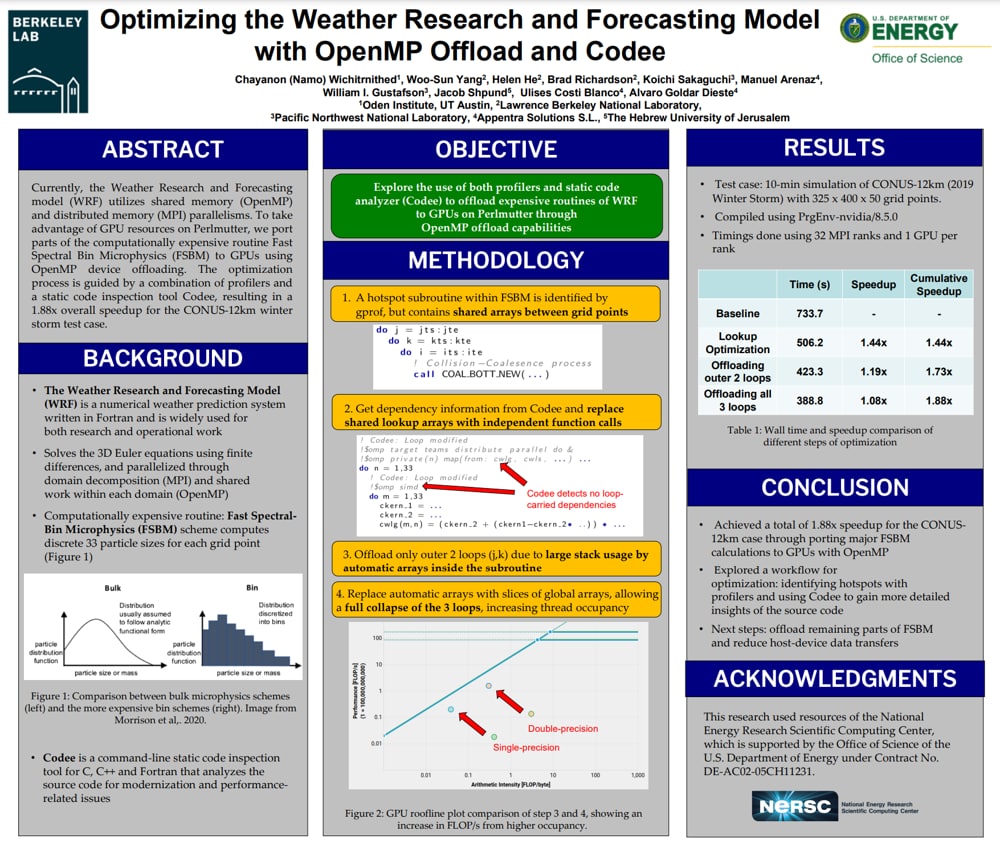
This work was showcased at SC24 in the WACCPD workshop.
Stay tuned as Codee continues to enhance performance in computational weather forecasting, making significant strides in both predictability and speed through optimization and code correctness.
Build correct, secure, modern and fast Fortran, C and C++ scientific software
 This company is capitalized by INNVIERTE, AN INVESTMENT PROGRAM OF CDTI, E.P.E
Leave a Reply